Templates
Employment Reference Letter Template – free for Word, PDF and Excel
Release
Version 2026.10
Markets
- UK
- IE
- US
Formats
- Excel (.xlsx)
- Google Sheets
- PDF (fillable)
- Word (.docx)
Editable files: free, after a short form
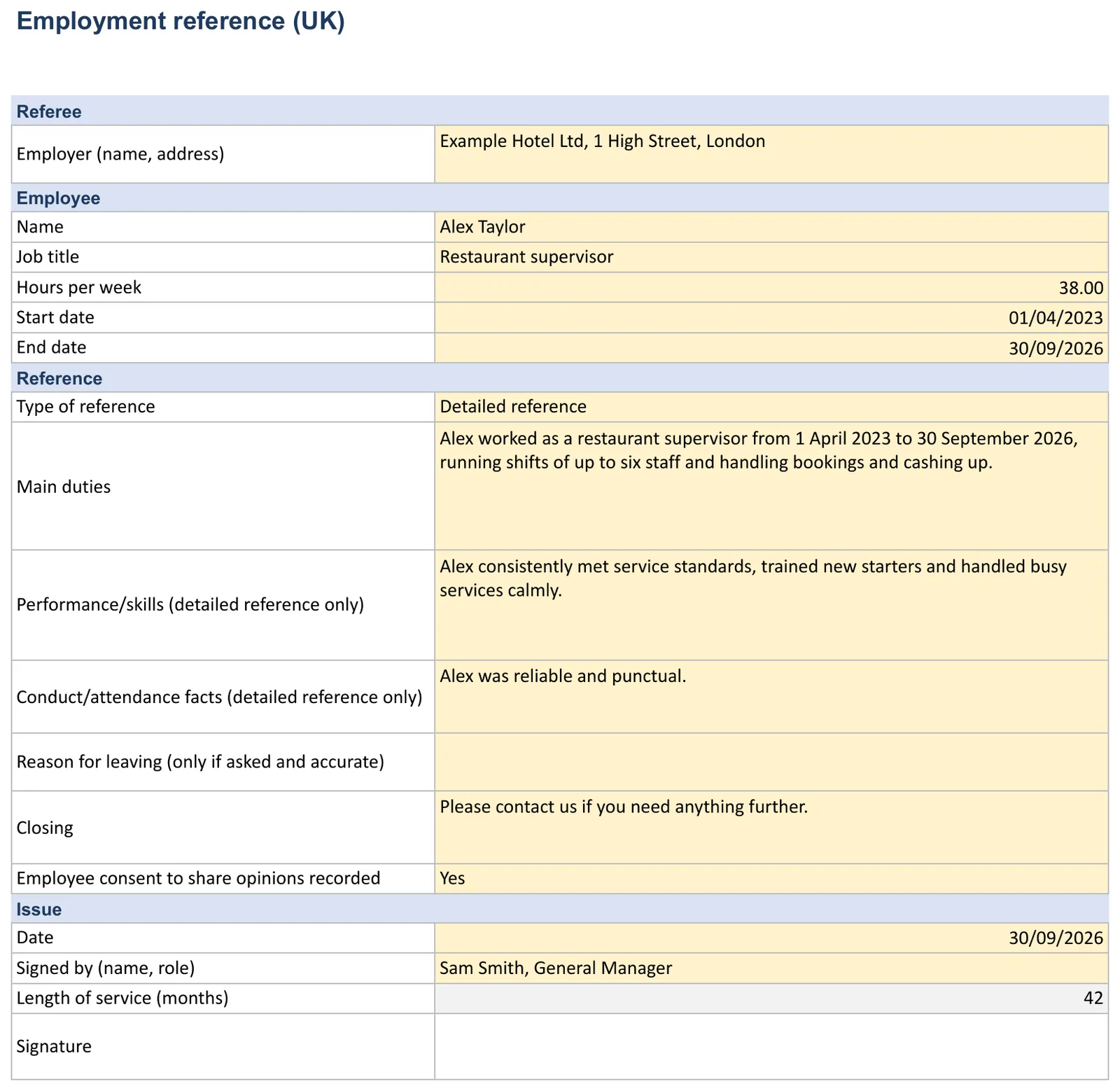
At a glance
At a glance
Formats
Excel (.xlsx), Google Sheets, PDF (fillable), Word (.docx)
Countries
United Kingdom, Ireland and United States
Automatic checks
6
Legal status
Guidance, not legal advice (checked October 2026)
What's in the template
What's in the template
Fill in
- Employer (name, address)
- Name
- Job title
- Hours per week
- Start date
- End date
- Type of reference
- Main duties
- Performance/skills (detailed reference only)
- Conduct/attendance facts (detailed reference only)
- Reason for leaving (only if asked and accurate)
- Closing
- Employee consent to share opinions recorded
- Date
- Signed by (name, role)
Automatic
Length of service (months)
Dropdowns
- Type of reference: Factual reference (dates and job title), Detailed reference
- Employee consent to share opinions recorded: Yes, No
How to fill in the template
How to fill in the template
- 1
On “Reference” fill in the yellow fields and choose factual or detailed.
- 2
Describe the main duties factually.
- 3
Only give opinions in a detailed reference, with the employee’s agreement – and only what you can back up.
- 4
Review “Checks” for ambiguous wording and sensitive data.
- 5
Send on headed paper or by email from a work account; keep a copy.
How the template calculates
How the template calculates
Formulas
The template drops your entries into the text or form automatically. The checks verify required details, date logic and deadlines and show ✔ or ⚠.
Quick tips
Fill in the yellow cells; grey cells calculate – don’t overwrite them. ✔ = OK, ⚠ = check. Enter times as hh:mm and dates as dates; add new dropdown values on the source sheet first. If you see #VALUE! or empty totals, press Ctrl+Z or reload the template.
Rules by country
Rules by country
verified·estimate·pending
Country notes
**United Kingdom
** The “Legal basis” sheet refers to UK law (Acas guidance, Spring v Guardian Assurance, FCA rules for regulated references).
**Ireland
** there is no legal requirement to give a reference; if you give references, give them to all employees without discrimination. A reference contains personal data – the EU GDPR applies.
**United States
** no federal law requires a reference, but under the laws enforced by the EEOC it is illegal to give a negative or false reference, or refuse one, because of a protected characteristic or in retaliation. State rules vary.
Legal basis and sources
| Rule | Source |
|---|---|
| Giving a reference: accurate and fair | Acas |
| Duty of care in references | [Spring v Guardian Assurance [1994] UKHL 7](https://www.bailii.org/uk/cases/UKHL/1994/7.html) |
| Special category data | UK GDPR Art. 9; ICO |
| Regulated references (financial services) | FCA SYSC 22 |
Guidance only, not legal advice – contracts and collective agreements can differ. The file holds personal data (UK GDPR / GDPR): share it only with people who need it and delete it once the retention period ends.
Checks and dashboard
Checks and dashboard
Required details complete
End date not before start
Content matches reference type
No ambiguous or coded wording
No special-category data
Consent / issue date recorded
Formats
Excel, Google Sheets, PDF or Word
PDF (fillable)
Print it or fill it in on screen, without formulas.
Word (.docx)
Edit the wording freely in Word or LibreOffice.
- Recommended
Excel (.xlsx)
Calculate, check and archive on your computer – Excel 2016 or later, Microsoft 365.
Google Sheets
Use it in the browser and share it with your team – via File › Make a copy.
Print, share, save
Print: File › Print → A4 (UK, Ireland) or US Letter (US), choose orientation, scale “Fit to width”, repeat frozen rows.
PDF/Excel: File › Download › PDF or Microsoft Excel (.xlsx).
Your own copy: File › Make a copy. Share: “Share” top right – ideally “Viewer” for the team.
Limits of the template
Formula cells are only protected with a warning, and a spreadsheet keeps no change log: anyone who can open the file can edit it.
If several people need to plan or record at the same time, software such as Ordio is easier.
Related templates and tools
- Digital employee files in Ordio
- Job Description Template – free for Word, PDF and ExcelFree job description template for Excel and Google Sheets. Job profile fields for recruiting, onboarding, and org alignment. Download now.
- Employment Certificate Template – free for Word, PDF and ExcelExcel letter confirming employment for a lender, landlord, or new employer. Job title, dates, and hours. Not a P45 or a benefits form.
- Employee Information Form Template – free for Word, PDF and ExcelFree employee information form template for Excel and Google Sheets. US W-4 and UK starter fields, bank details, and new-hire data. Download now.
- Termination Letter Template – free for Word, PDF and ExcelExcel letter stating the last day of work, for a resignation or an employer notice. Not a German BGB notice table. Use the contract.
- Onboarding Checklist Template – free for Word, PDF and ExcelFree onboarding checklist template for Excel and Google Sheets. Onboarding tasks, owners, deadlines, and progress for new hires. Download now.
Do you have to give a reference?
In the UK there is no general legal duty to give a reference. Some regulated sectors are the exception, for example financial services firms covered by the FCA's regulatory reference rules (SYSC 22). The same applies in Ireland and under US federal law. Once you do give a reference, rules apply:
- UK: a reference must be true, accurate and fair. Following *Spring v Guardian Assurance* [1994], an employer owes a duty of care to the subject of the reference, and a careless, misleading reference can lead to a claim. Acas advises that it should not give a misleading overall impression, even if each statement is technically true.
- Ireland: there is no requirement to give references. If you give them, give them to all employees on the same basis, without discrimination.
- United States: no federal law requires a reference. Under the laws enforced by the EEOC it is illegal to give a negative or false reference, or to refuse one, because of a protected characteristic or in retaliation for a complaint. State laws vary.
Factual or detailed: choose the type first
| Type | Contains | When to use |
|---|---|---|
| Factual | Job title, dates of employment, possibly main duties | Default; company policy in many organisations |
| Detailed | Also skills, performance and character | Only with the employee's agreement, and only what you can back up |
Many employers have a policy of giving factual references only. That is lawful, but apply it consistently. If you give detailed references to some leavers and only dates to others, the difference itself can send a message.
Writing a fair detailed reference
- Evidence for every opinion. "Managed rotas for a team of 12 and cut overtime by planning two weeks ahead" can be backed up. "The best supervisor we ever had" cannot.
- No coded language. Phrases that sound positive but signal a problem ("worked to the best of her ability") are exactly what makes a reference unfair. The "Checks" sheet flags common examples.
- Don't leave out what matters. If there were serious, proven conduct issues relevant to the new role, leaving them out can also mislead. Stick to facts that were investigated.
- No special-category data. Health, sickness absence, pregnancy, religion or trade union membership do not belong in a reference (UK GDPR Art. 9). If absence levels are genuinely relevant, get advice and the employee's consent first.
Sending and keeping a copy
Send the reference on headed paper or from a work email account, marked "private and confidential". Keep a copy on file with the date and the person it was sent to. The employee may ask to see the information held about them. Record the employee's consent for a detailed reference in the template.
Before you send it
Read the reference once as the new employer would. Is every statement true, and could you show where it comes from? Would the employee recognise themselves in it? If either answer is no, rewrite that sentence.
Sample wording: factual and detailed
Factual reference (what many employers give by default):
Morgan Patel was employed by Example Hotels Ltd from 4 April 2022 to 30 September 2026 as a Front Office Supervisor. Main duties: running the evening shift, staff rotas for a team of eight, and handling guest complaints. This reference is given in confidence for the use of the addressee only.
Detailed reference, adding evidence-based comments:
Morgan planned rotas two weeks ahead, which cut short-notice overtime. Guests regularly mentioned Morgan by name in positive reviews. Morgan's attendance record was good.
Each statement in the detailed version can be checked against rotas, reviews or attendance records. That is the test the Acas guidance points to: a reference has to be accurate and fair.
Phrases to avoid, and what to write instead
| Avoid | Problem | Better |
|---|---|---|
| "Took a lot of sick leave" | Health data, and possibly disability-related | Leave it out, or give only facts you are sure you may share |
| "Not a team player" | Opinion with no evidence | Describe a specific, documented issue, or say nothing |
| "We would not re-employ" without reasons | Can mislead; may be unfair | State your policy, e.g. "We only provide factual references" |
| "Young and energetic" | Refers to age, a protected characteristic | "Quick to learn new systems" |
When the employee disagrees
An employee who thinks a reference is inaccurate can ask you for a copy under the UK GDPR right of access. If an inaccurate or careless reference causes them loss, they may be able to claim damages: in Spring v Guardian Assurance the House of Lords held that an employer owes a duty of care when writing a reference. Keep your notes on where each statement comes from.
Regulated roles
Financial services firms covered by the FCA's regulatory reference rules (SYSC 22) must share certain information, for example about fitness and propriety, and cannot simply give a factual one-liner. Check those rules before using this template for such a role.
For the employee
Ask early who will give your reference and what type your employer usually provides. If you know it will be factual only, ask a former line manager for a personal reference as well, and give their details on your application.
A short checklist before signing
- Every fact matches the personnel file: dates, job title, reason for leaving.
- No health, sickness absence or other special-category data.
- Opinions are backed by something you could show.
- Marked "private and confidential" and sent to the named person only.
- Copy filed with the date sent.
If you can't confirm a fact, leave it out rather than guess: a short accurate reference is safer than a long uncertain one. Keep your notes with the copy.
Can the candidate see the reference? (UK)
A reference given in confidence for someone's employment, education or training is exempt from the UK GDPR right of access (Data Protection Act 2018, Schedule 2, paragraph 24). So a candidate cannot simply use a subject access request to get a copy of a confidential reference. The exemption only covers references that really were given in confidence, so write every reference as if the candidate will read it.
Keep the signed reference in the employee file
The workbook drafts the German Arbeitszeugnis. Ordio stores the signed copy with the employee record.
Signed copy on the record
Store the PDF next to the contract and the employment certificate
HR access only
References stay out of shared drives and inboxes
One file at exit
Reference, employment certificate, and termination letter in the same record
Less searching later
The rating phrases stay in the workbook. The signed copy stays in the file.
With Ordio:
- Digital employee files
Store the signed Arbeitszeugnis with the employee record
- Document management
Keep the reference, the certificate, and the termination letter together
- Payroll
Employment dates stay available when HR writes the reference
- Absences
Leave dates stay on the record when the reference is written
See how Ordio supports HR documentation
See automatic checks improve audit readiness · No obligation · 15 minutes
More free templates
Discover more Excel templates for planning, time tracking and HR.
Frequently asked questions about German employment reference
How can I request a qualified Employment reference?
Request it in writing - by e-mail or letter. The best before or at the latest at the end of the employment relationship. Formulations: "I would like to issue a qualified employment reference." The employer must issue within a reasonable period of time. Use a template like that of Ordio to check whether all mandatory information is included.
When should I request a simple or qualified Employment reference?
A simple Employment reference contains only the type and duration of the work - suitable for minijobs or helpers. A qualified reference additionally evaluates performance and behavior. Ask a qualified person if you want to apply: It shows potential employers how you worked. You have the right to vote - the employer must respect your choice.
Can I refuse to give a reference?
Usually yes. In the UK, Ireland and under US federal law there is no general duty to give one, except in some regulated sectors. But a refusal must not be discriminatory or retaliatory, and any reference you do give must be true, accurate and fair.
Is the employment reference letter template free, and does it work in Excel and Google Sheets?
Yes. You download it free of charge after a short form and get an Excel file (.xlsx, Excel 2016 or Microsoft 365) and a Google Sheets copy, plus a fillable PDF and a Word document. Excel and Sheets contain the same 5 sheets: Instructions, Reference, Checks, Legal basis, Ordio.
Which countries does the template cover?
The template covers the United Kingdom, Ireland and the United States. The country notes in the file set out the rules for each: United Kingdom: The “Legal basis” sheet refers to UK law (Acas guidance, Spring v Guardian Assurance, FCA rules for regulated references). Ireland: there is no legal requirement to give a reference; if you give references, give them to all employees without discrimination. A reference contains personal data – the EU GDPR applies. United States: no federal law requires a reference, but under the laws enforced by the EEOC it is illegal to give a negative or false reference, or refuse one, because of a protected characteristic or in retaliation. State rules vary. Note: Guidance only, not legal advice. Status: October 2026.